Relation among DSM, LKM and EDM
With regard to the relation to the stochastic models, there is a notable paper Felinger et al. (2004) which suggests:
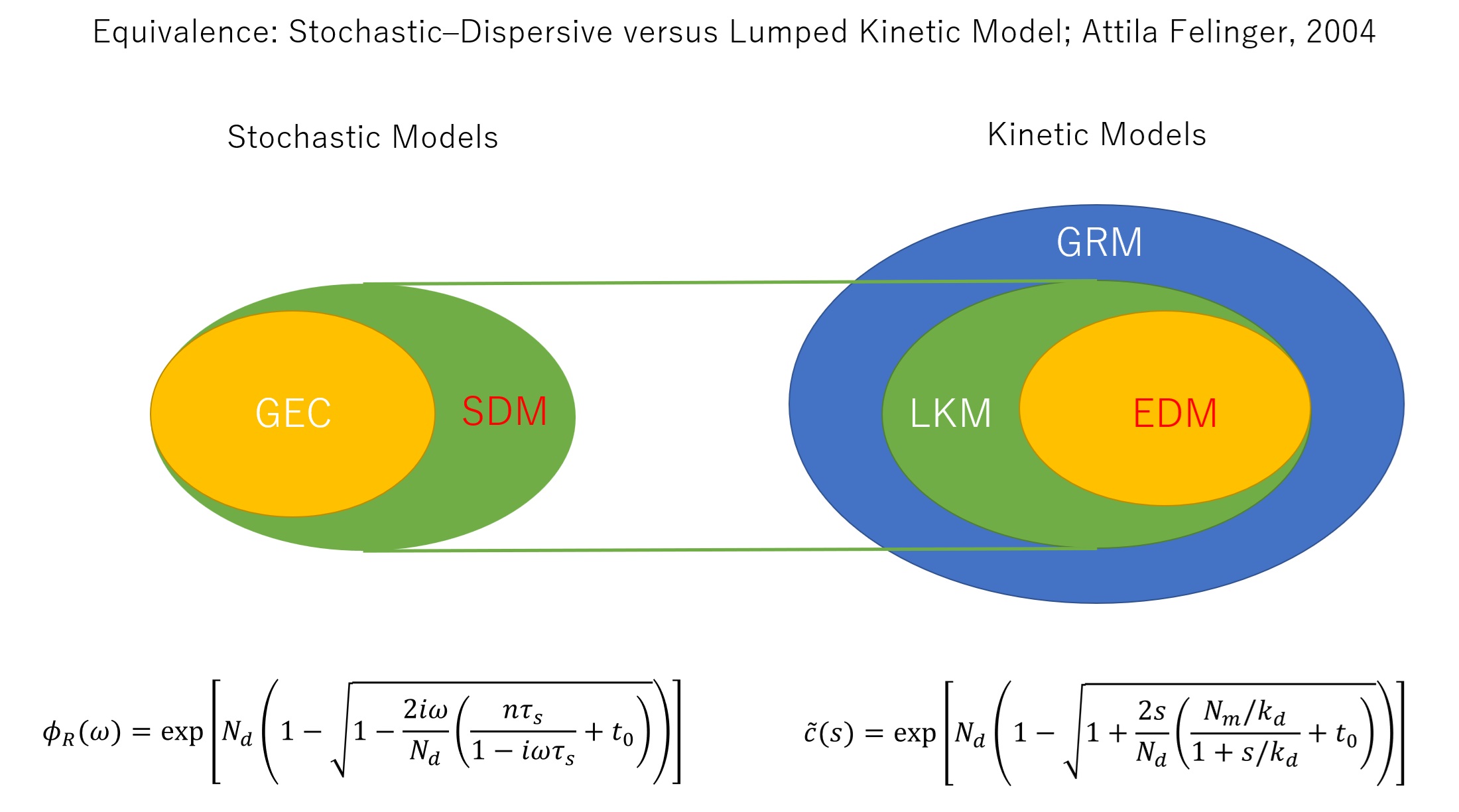
Figure 1:SDM-LKM Equivalence
Notational Correspondence in Relevant Papers
Here are summarized notational correspondence among the relevant papers:
Dondi, 2002 Dondi et al. (2002)
Felinger, 2004 Felinger et al. (2004)
Rheman, 2021 Ur Rehman et al. (2021)
Table 1:Summary of Notational Correspondence between SDM and { LKM EDM }
Dondi-2002 SDM | Felinger-2004 LKM | Rehman-2021 EDM | Parameter Despription |
|---|---|---|---|
Number of Plates in Mobile Zone; | |||
Average Number of Stays in Stagnant Zone; ; | |||
Average Time of Stays in Stagnant Zone; | |||
(porosity) | (porosity) | ; ; ; |
SymPy Examples to Understand the Papers
To follow the papers, you can use SymPy. Here are some examples.
from sympy import symbols, Eq, Function, dsolvef, g = symbols("f g", cls=Function)
x = symbols("x")
eqs = [Eq(f(x).diff(x), g(x)), Eq(g(x).diff(x), f(x))]
dsolve(eqs, [f(x), g(x)])[Eq(f(x), -C1*exp(-x) + C2*exp(x)), Eq(g(x), C1*exp(-x) + C2*exp(x))]dsolve(eqs, [f(x), g(x)], ics={f(0): 1, g(2): 3})[Eq(f(x), (1 + 3*exp(2))*exp(x)/(1 + exp(4)) - (-exp(4) + 3*exp(2))*exp(-x)/(1 + exp(4))),
Eq(g(x), (1 + 3*exp(2))*exp(x)/(1 + exp(4)) + (-exp(4) + 3*exp(2))*exp(-x)/(1 + exp(4)))]eqn = Eq(f(x).diff(x), f(x))
dsolve(eqn, f(x), ics={f(x).diff(x).subs(x, 1): 2})Loading...
from sympy import symbols, Function, dsolve
t = symbols('t')
y = Function('y')(t)
y
Loading...
yp = y.diff(t)
ypp = yp.diff(t)
eq = ypp + 2*yp + y
eq
Loading...
dsolve(eq, y)Loading...
dsolve(eq, y, ics={y.subs(t, 0): 0})Loading...
- Felinger, A., Cavazzini, A., & Dondi, F. (2004). Equivalence of the microscopic and macroscopic models of chromatography: stochastic–dispersive versus lumped kinetic model. Journal of Chromatography A, 1043(2), 149–157. https://doi.org/10.1016/j.chroma.2004.05.081
- Dondi, F., Cavazzini, A., Remelli, M., Felinger, A., & Martin, M. (2002). Stochastic theory of size exclusion chromatography by the characteristic function approach. Journal of Chromatography A, 943(2), 185–207. https://doi.org/10.1016/S0021-9673(01)01443-1
- Ur Rehman, J., Muneer, A., & Qamar, S. (2021). Analysis of equilibrium dispersive model of liquid chromatography considering a quadratic-type adsorption isotherm. Thermal Science, 26(3), 2069–2080. 10.2298/TSCI201229179U