General Note
References:
Definition for SEC-SAXS Solution Context
For the discussion in the following chapters, the definitions of form factor and structure factor are presented here. According to Gommes et al. (2021), these two factors are pedagogically distinguished as follows:
form factor — scattering by individual particles
structure factor — scattering by collections of particles
In simple terms, we can understand them pragmatically as:
when interpaticle effects are ignored (i.e., in this case)
when interpaticle effects are considered.
Form Factor
For an individual particle, the form factor is defined as
where
: scattered intensity
: electron density
: particle volume
: form factor (normalized so that P(q) = 1 for small q).
For a sample, ignoring interparticle effects, it can be written as
where
: particle concentration.
Structure Factor
When you consider the interparticle effects, they are expressed as
where
: structure factor.
In other words, we can just think that the structure factor is a reprentaion of interparticle effects.
Form Factor Models
Following Pedersen (1997), we will give some known examples of form factor models.
Homogeneous Sphere
from molass import get_version
assert get_version() >= '0.5.0', "This tutorial requires molass version 0.5.0 or higher."
import numpy as np
import matplotlib.pyplot as plt
from molass.Shapes import Sphere
from molass.DensitySpace import VoxelSpace
from molass.SAXS.Models.Formfactors import homogeneous_sphere

q = np.linspace(0.005, 0.7, 100)
R = 30

I = homogeneous_sphere(q, R)

sphere = Sphere(radius=10)
space = VoxelSpace(64, sphere)

fig = plt.figure(figsize=(12, 5))
fig.suptitle('Form factor of a Homogeneous Sphere')
ax1 = fig.add_subplot(121, projection='3d')
ax1.set_title('Electron density')
space.plot_as_dots(ax1)

ax2 = fig.add_subplot(122)
ax2.set_title('SAXS intensity')
ax2.set_yscale('log')
ax2.plot(q, I, label='Analitical formula')
ax2.legend()
ax2.set_xlabel('q (1/Å)')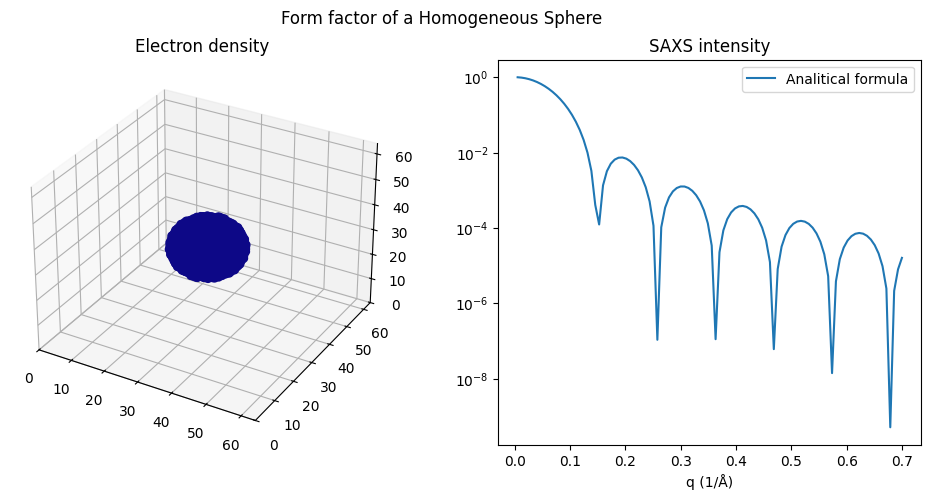
Tri-axial Ellipsoid
from molass.Shapes import Ellipsoid
from molass.DensitySpace import VoxelSpace
from molass.SAXS.Models.Formfactors import tri_axial_ellipsoid
I = tri_axial_ellipsoid(q, 30, 20, 10)

ellipsoid = Ellipsoid(30, 20, 10)
space = VoxelSpace(64, ellipsoid)

fig = plt.figure(figsize=(12, 5))
fig.suptitle('Form factor of a Tri-axial Ellipsoid')
ax1 = fig.add_subplot(121, projection='3d')
ax1.set_title('Electron density')
space.plot_as_dots(ax1)

ax2 = fig.add_subplot(122)
ax2.set_title('SAXS intensity')
ax2.set_yscale('log')
ax2.plot(q, I, label='Analitical formula')
ax2.legend()
ax2.set_xlabel('q (1/Å)')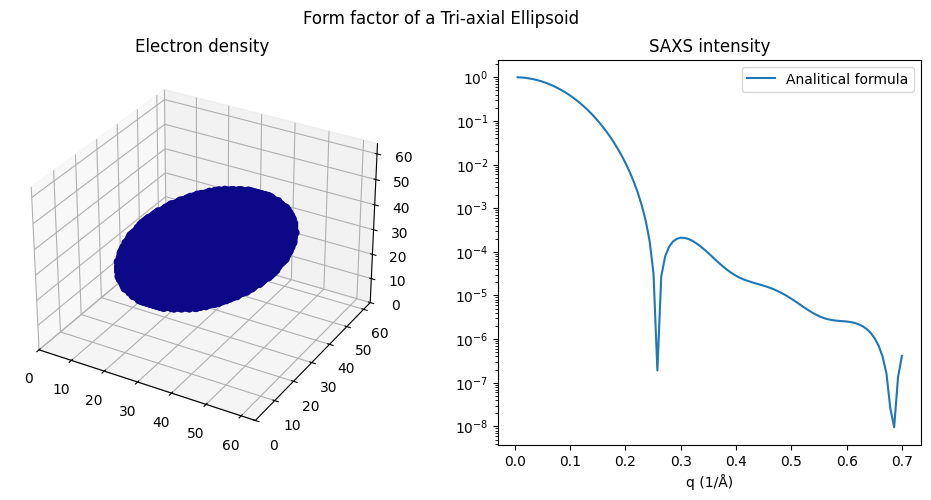
Structure Factor Models
Following Kinning & Thomas (1984), we will give some known examples of structure factor models.
from molass import get_version
assert get_version() >= '0.5.0', "This tutorial requires molass version 0.5.0 or higher."
from molass.SAXS.Theory.DjKinning1984 import demo1
demo1()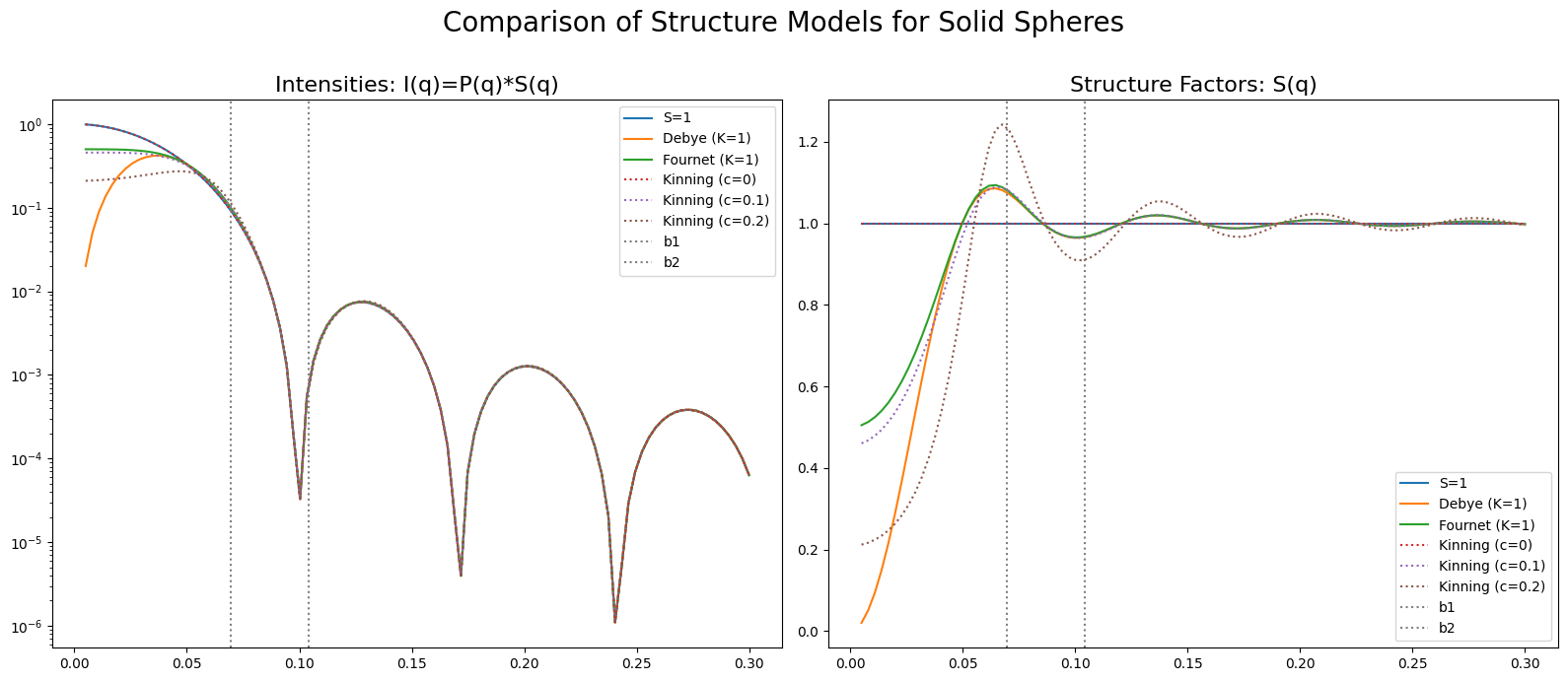
- Gommes, C. J., Jaksch, S., & Frielinghaus, H. (2021). Small-angle scattering for beginners. Journal of Applied Crystallography, 54(6), 1832–1843. 10.1107/S1600576721010293
- Pedersen, J. S. (1997). Analysis of small-angle scattering data from colloids and polymer solutions: modeling and least-squares fitting. Advances in Colloid and Interface Science, 70, 171–210. https://doi.org/10.1016/S0001-8686(97)00312-6
- Kinning, D. J., & Thomas, E. L. (1984). Hard-sphere interactions between spherical domains in diblock copolymers. Macromolecules, 17(9), 1712–1718.